Customers today expect instant, helpful, and human conversations on every channel. A conversational AI platform gives you exactly that: the power to automate and scale personalized interactions without sacrificing quality or empathy. With features like Virtual Agent Assist, businesses can enhance every interaction, improving the virtual agent assist customer experience across voice, chat, and messaging channels.
Organizations can explore practical guides for building smarter virtual agents to stay ahead in AI-driven communication. Some teams look at high-performance computing solutions for AI interactions to ensure their systems respond quickly and reliably. Marketers can learn from AI strategies that enhance customer engagement to create more meaningful conversations. Likewise, advanced marketing tools for customer-first AI platforms help businesses maintain personalized support at scale. Finally, essential financial resources for deploying AI contact centers make sure every AI-powered interaction is efficient, cost-effective, and human-centered.
In this guide, you will learn what a conversational AI platform is, how it works, where it delivers the biggest impact, and how to choose and implement the right solution for your business.
Top Conversational AI Platforms for Contact Center Solutions
1. Bright Pattern
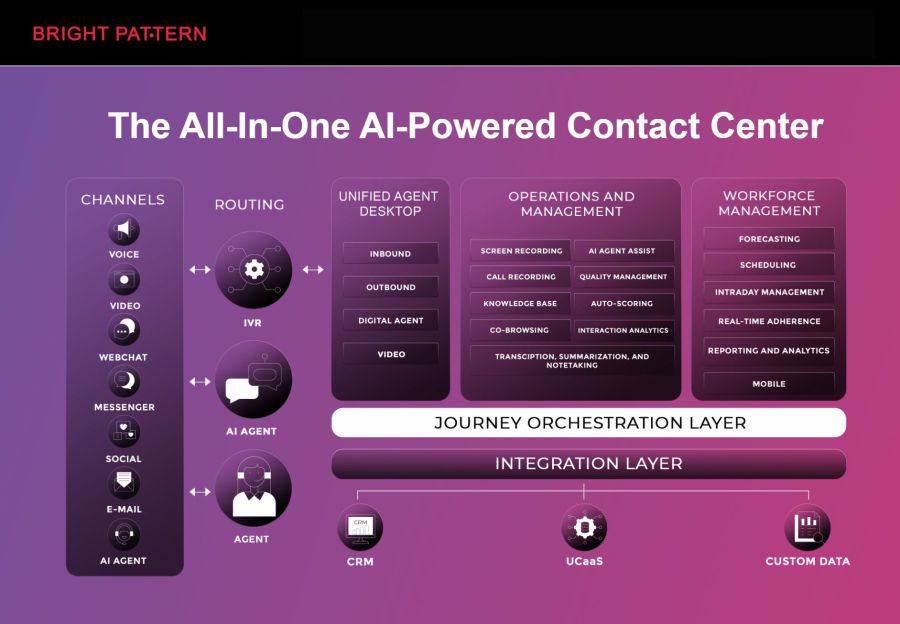
Bright Pattern is a leading conversational AI platform designed to transform contact centers with intelligent automation and personalized customer interactions. It enables businesses to streamline operations, improve agent productivity, and enhance customer satisfaction.
Key features include:
- Virtual Agent Assist to guide agents and handle routine queries
- Omnichannel support across voice, chat, messaging, and social platforms
- AI-driven analytics to monitor performance and improve outcomes
- Seamless integration with CRM, marketing, and support systems
Bright Pattern’s platform allows call centers to scale while maintaining human-like conversations, helping deliver an exceptional customer experience across every interaction.
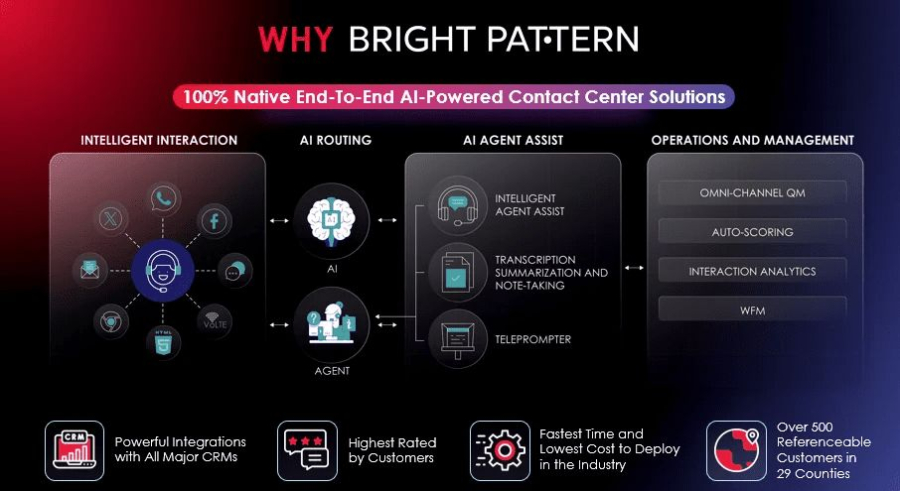
2. Vonage Contact Center
Vonage provides AI-powered contact center solutions that help companies manage customer interactions across multiple channels.
3. Freshdesk Contact Center
Freshdesk offers an intuitive platform for call centers, integrating AI automation to route tickets, provide agent assistance, and optimize customer support.
4. Genesys Cloud Contact Center
Genesys Cloud combines AI automation and workforce engagement tools to improve efficiency and deliver consistent omnichannel customer experiences.
5. Five9 Intelligent Cloud Contact Center
Five9 delivers AI-enhanced call center solutions with predictive dialing, virtual assistants, and CRM integrations to optimize agent workflows.
6. Talkdesk AI Contact Center
Talkdesk provides an AI-driven platform for contact centers with features like virtual agents, real-time guidance, and analytics for performance optimization.
7. NICE inContact CXone
NICE inContact CXone integrates AI-powered routing, automation, and omnichannel support to improve service levels and customer satisfaction.
8. RingCentral Contact Center
RingCentral’s contact center solution leverages AI for virtual agent support, analytics, and omnichannel customer engagement.
9. 8x8 Contact Center Solutions
8x8 offers an AI-enhanced platform to streamline contact center operations with intelligent routing, analytics, and multi-channel support.
10. Cisco Webex Contact Center
Cisco Webex Contact Center integrates AI and automation to provide personalized customer service, real-time guidance, and robust reporting tools.
What Is a Conversational AI Platform?
A conversational AI platform is a software solution that uses artificial intelligence to understand, respond to, and manage two-way conversations with users through text or voice.
Think of it as the brain and control center behind chatbots, virtual agents, and voice assistants that can answer questions, complete tasks, and guide customers end to end.
Unlike simple rule-based chatbots that follow fixed scripts, a true conversational AI platform can:
- Understand natural languagerather than just keywords.
- Handle flexible, multi-turn conversationsthat jump between topics.
- Connect to your systems(CRM, order systems, knowledge bases) to take real actions.
- Learn and improve over timeusing data and feedback.
Key Components of a Conversational AI Platform
Behind every seamless conversation is a stack of AI and automation capabilities working together. Here are the core building blocks of most conversational AI platforms.
1. Natural Language Understanding (NLU)
Natural Language Understandingis the technology that allows the platform to grasp what users mean, not just what they type or say. NLU typically does three main things:
- Intent detection— identifying what the user wants to achieve, such astrack orderorreset password.
- Entity recognition— extracting important details like dates, order numbers, product names, or locations.
- Sentiment or emotion analysis— understanding if the user is frustrated, satisfied, or neutral.
This is what makes interactions feel natural and reduces the need for rigid menu trees or keyword triggers.
2. Dialogue Management
Dialogue management is theconversation logic enginethat decides how the AI should respond step by step. It manages:
- Context— what has already been asked and answered in the conversation.
- Flows— the paths the conversation can take to achieve a goal, like completing an order or submitting a claim.
- Fallbacks— what happens if the AI does not understand or lacks data.
Well-designed dialogue management creates experiences that feel coherent, helpful, and human-like from the first message to resolution.
3. Integrations and Connectors
A conversational AI platform is most powerful when it isdeeply connected to your tech stack. Typical integrations include:
- Customer relationship management (CRM) tools.
- Ticketing and helpdesk systems.
- Ecommerce and order management platforms.
- Payment gateways and billing systems.
- Knowledge bases and FAQs.
These integrations let the AI not only answer questions, but also perform actions like updating an address, processing a refund, or booking an appointment.
4. Omnichannel Orchestration
Modern conversational AI platforms typically support multiple channels, such as:
- Web and mobile chat widgets.
- Messaging apps and social channels.
- Email and SMS.
- Voice channels and call centers.
The biggest advantage is that you can maintainconsistent experiences and shared contextacross channels. A customer can start a chat on your website and later call in, and the agent or voice bot can pick up where the conversation left off.
5. AI Training, Analytics, and Optimization
A robust conversational AI platform does not stand still. It gives you tools to:
- Train and refine language modelsusing real conversation data.
- Analyze performancewith dashboards and reports.
- A/B test flows and messagesto increase resolution rates and conversions.
- Gather feedbackfrom users post-conversation.
This continuous improvement loop is how organizations move from simple automation to genuinely delightful, high-impact experiences.
Why Businesses Are Investing in Conversational AI Platforms
Across industries, companies are turning to conversational AI for one main reason: it helps them do more with less while giving customers a better experience. Here are some of the most compelling benefits.
1. 24/7 Support Without 24/7 Headcount
Conversational AI platforms allow you to offer round-the-clock support without staffing a large night shift. The AI can handle a big portion of common interactions at any time, including:
- Answering FAQs and policy questions.
- Status checks, such as orders, deliveries, or reservations.
- Simple account actions, like password resets or profile updates.
Your customers get instant answers, even on weekends and holidays, while your team can focus on complex, high-value work.
2. Faster Response Times and Higher Satisfaction
Long wait times in queues are a major driver of customer frustration and churn. With a conversational AI platform, first response times drop from minutes to seconds.
Many organizations report significant improvements in:
- Customer satisfaction (CSAT)thanks to instant, accurate responses.
- Net Promoter Score (NPS)as customers feel more supported and valued.
- Resolution timeas simple issues are solved in a single interaction.
Faster help often translates directly into stronger loyalty.
3. Lower Support and Operations Costs
By automating large volumes of repetitive interactions, conversational AI platforms help reduce the cost per contact. Typical outcomes include:
- Deflection of routine ticketsfrom live agents to AI.
- Shorter average handle timewhen agents step in, because the AI has already gathered context.
- Scalable operationsduring peak seasons without proportional headcount increases.
This makes it easier to grow your customer base without seeing costs rise at the same pace.
4. Increased Revenue and Conversions
Conversational AI is not only for support. When connected to your marketing and sales funnels, it becomes a powerful growth driver. For example, platforms can:
- Qualify leads in real timeby asking questions and routing hot prospects.
- Recommend products or plansbased on customer needs and behavior.
- Recover abandoned cartsby answering last-minute questions or offering guidance.
- Upsell or cross-sellduring service interactions when relevant.
The result is more revenue from the traffic and customers you already have.
5. Better Data and Customer Insights
Every conversation is a rich source of insight. A conversational AI platform centralizes this data and turns it into actionable learnings, such as:
- Common questions and pain points customers face.
- Product or process issues that appear repeatedly.
- Language and phrasing customers naturally use.
- Sentiment trends over time.
These insights can inform product roadmaps, content strategies, and service improvements across your organization.
Popular Use Cases for Conversational AI Platforms
Conversational AI can be applied wherever your customers or employees need quick, reliable answers. Below are some high-impact use cases.
Customer Support and Service
- Instant responses to FAQs.
- Order tracking and shipping updates.
- Basic troubleshooting and guided diagnostics.
- Account and subscription management.
- Smart routing to human agents when needed.
A well-designed platform acts as the first line of support, with seamless handoffs to agents for complex issues.
Sales Assistance and Lead Generation
- Interactive product finders and recommendations.
- Pre-qualifying and scoring leads.
- Scheduling demos and consultations.
- Answering pricing, feature, and compatibility questions.
This turns your website or app into an always-on sales assistant that guides visitors toward the right solution.
Onboarding and Customer Education
- Guiding new users through setup and first steps.
- Offering contextual tips within your product.
- Delivering personalized tutorials based on user goals.
Conversational guidance helps customers reach value faster and reduces early churn.
Internal Support and Employee Productivity
Conversational AI platforms are also powerful tools for internal teams. Common scenarios include:
- IT support bots that resolve common technical issues.
- HR assistants that answer policy and benefits questions.
- Knowledge search assistants that surface internal documentation quickly.
This frees up internal experts and helps employees stay focused and productive.
Comparing Conversational AI Platforms: What Matters Most
Not all platforms are created equal. While every solution will promise automation and AI, the difference lies in how well they fit your business. Below is a simple comparison framework to help you evaluate options.
|
Evaluation Area |
What to Look For |
Why It Matters |
|
Language Understanding |
High intent accuracy, support for your key languages, robust entity extraction. |
Ensures the AI actually understands what users mean, reducing frustration. |
|
Conversation Design |
No-code or low-code flow builders, reusable templates, flexible logic. |
Makes it easier for your team to design and update experiences quickly. |
|
Integrations |
Connectors to your CRM, helpdesk, commerce, and internal systems. |
Allows the AI to perform real actions, not just answer basic questions. |
|
Omnichannel Support |
Coverage of your priority channels with shared context and analytics. |
Delivers consistent experiences wherever your customers engage. |
|
Analytics and Optimization |
Dashboards, conversation transcripts, training tools, A/B testing. |
Supports continuous improvement and higher automation rates over time. |
|
Security and Compliance |
Data encryption, access controls, compliance with relevant standards. |
Protects customer data and aligns with regulatory requirements. |
|
Scalability |
Ability to handle spikes in volume and multiple teams or regions. |
Ensures performance stays strong as your business grows. |
|
Human Handoff |
Seamless transfer to agents with full context and history. |
Delivers the best of both worlds: automation plus human empathy. |
How to Choose the Right Conversational AI Platform
To select a platform that delivers real business value, it helps to follow a structured process rather than just comparing feature checklists.
Step 1: Clarify Your Business Goals
Start by defining what success looks like. Common goals include:
- Reducing support costs by automating a percentage of tickets.
- Improving CSAT or NPS scores.
- Boosting lead conversion or average order value.
- Shortening onboarding time for new customers.
Clear goals will guide your platform choice and help you measure ROI later.
Step 2: Map High-Impact Use Cases
Identify where conversational AI can create quick, visible wins. Look for:
- High-volume, repetitive questions in support channels.
- Points of friction in your sales or signup funnels.
- Manual internal processes that slow teams down.
Start with a few focused use cases rather than trying to automate everything at once.
Step 3: Involve Stakeholders Early
Conversational AI success is a team effort. Involve people from:
- Customer support or success.
- Sales and marketing.
- Product and UX.
- IT, security, and data protection.
Early input makes adoption smoother and ensures the platform meets real-world needs.
Step 4: Evaluate Platforms with Proof-of-Concepts
Once you have a shortlist, run small, time-boxed pilots. During evaluation, pay close attention to:
- How quickly you can build and launch a simple use case.
- How well the AI understands real customer messages.
- How easy it is to connect your core systems.
- The quality of analytics and training tools.
Pilots reveal practical strengths and limitations that are not always obvious from demos or documentation.
Step 5: Plan for Growth and Governance
As your conversational AI program matures, you will likely expand into new channels, regions, and use cases. Consider:
- Who owns conversation design and optimization.
- How you will prioritize new automations.
- What guidelines you will set for tone of voice and brand.
- How you will ensure privacy, security, and compliance.
A solid governance plan keeps your platform aligned with business and customer needs over time.
Launching Your First Conversational AI Experience
When you are ready to go live, a structured rollout can dramatically increase adoption and success. Here is a practical launch blueprint.
1. Start Small but Meaningful
Choose a use case that is focused, frequent, and easy to automate, such as:
- Order status updates.
- Basic account questions.
- Common product information queries.
This helps you prove value quickly, gather data, and build internal confidence.
2. Design with the Customer in Mind
Effective conversational experiences are not just about AI — they are about empathy and clarity. When designing flows:
- Use clear, friendly language that matches your brand voice.
- Offer suggested replies or quick-reply options to guide users.
- Be transparent when users are talking to AI rather than a person.
- Always provide an escape route to a human agent.
This builds trust and keeps satisfaction high, even when automation is handling the bulk of the work.
3. Train, Test, and Refine
Before launch, use sample conversations and historical transcripts to train your AI. Then, thoroughly test:
- Whether intents are correctly recognized.
- How the conversation flows in edge cases.
- How gracefully the system handles unknown questions.
After launch, review transcripts regularly to spot gaps, refine wording, and add new intents.
4. Measure What Matters
Set up clear metrics tied to your original goals. Common KPIs for conversational AI platforms include:
- Containment rate— the percentage of interactions fully handled by AI.
- Average handle timefor human agents post-handoff.
- Customer satisfaction scoresfor automated interactions.
- Conversion ratefor sales or lead-related flows.
Use these metrics to highlight wins, secure further investment, and guide the roadmap.
Real-World Impact: What Organizations Typically See
While every organization is unique, many teams experience similar patterns of value from conversational AI platforms. Common outcomes include:
- Significant automation of inbound volumefor common questions and tasks.
- Noticeable uplift in customer satisfactionas response times drop and availability improves.
- More productive support teamsthat can focus on high-value, complex cases.
- New revenue opportunitiesthrough proactive recommendations and lead capture.
Over time, these improvements compound, turning conversational AI into a strategic asset rather than a simple support tool.
The Future of Conversational AI Platforms
The capabilities of conversational AI are advancing rapidly. Looking ahead, you can expect platforms to become:
- More context-awareby understanding customer history, preferences, and behaviors in real time.
- More proactiveby offering timely suggestions instead of just reacting to questions.
- More multimodalby combining text, voice, and even visual elements in a single experience.
- More collaborative with humansby assisting agents in the background during live conversations.
For businesses, this means even greater opportunities to personalize, streamline, and elevate every interaction.
Bringing It All Together
A conversational AI platform is much more than a chatbot. It is a strategic layer that connects your customers, your teams, and your data through natural, intelligent conversations.
By choosing the right platform and rolling it out thoughtfully, you can:
- Delight customers with fast, helpful, always-on support.
- Empower teams by removing repetitive work and surfacing insights.
- Unlock new revenue through guided selling and personalized experiences.
The organizations that lean into conversational AI today are not just cutting costs — they are reshaping how they build relationships with customers, one conversation at a time.
